



Balsalazide USP Impurity 4
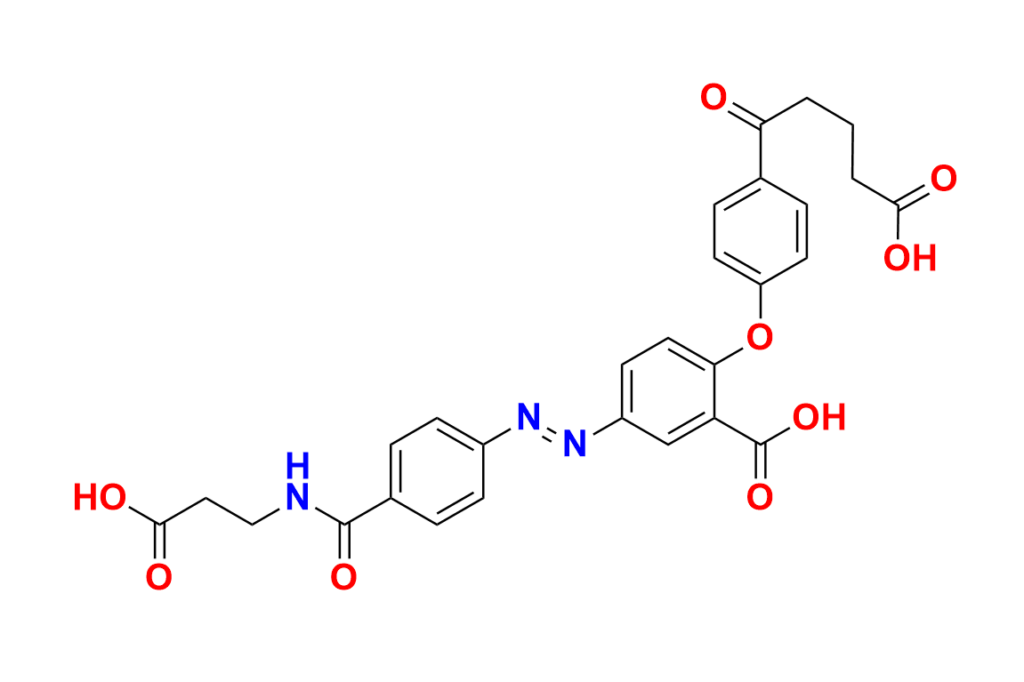
In Stock
| CAT NO | AQ-B000515 |
|---|---|
| CAS NO | 1346606-62-9 |
| Mol.F | C28H25N3O9 |
| Mol.Wt | 547.51 |
| Availability | In Stock |
| Chemical name | 2-(4-(4-Carboxybutanoyl)phenoxy)-5-((4-((2-carboxyethyl)carbamoyl)phenyl)diazenyl)benzoic acid |
Ready To Dispatch Within 24 Hours
In Stock
Request for Quotation :
Balsalazide USP Impurity 4


Product Description
Balsalazide USP Impurity 4 is a high-quality reference standard supplied with comprehensive characterization data, ensuring compliance with regulatory guidelines. This product is essential for analytical method development, method validation (AMV), quality control (QC) applications, and plays a crucial role in Abbreviated New Drug Applications (ANDA).
Balsalazide USP Impurity 4 can be used as a reference standard, with possible traceability to pharmacopeial standards such as USP or EP, based on feasibility. AquigenBio products are strictly for analytical purposes and is not intended for human use.
Applications of Balsalazide USP Impurity 4:
1. Pharmaceutical Impurity Profiling
-
Used as a known and qualified impurity standard associated with the Balsalazide active pharmaceutical ingredient (API).
-
Supports the identification and quantification of related substances in Balsalazide bulk and finished dosage forms.
-
Helps establish impurity profiles in accordance with USP monograph specifications.
2. Analytical Method Development & Validation
-
Essential for developing and validating stability-indicating analytical methods, including:
-
HPLC
-
UPLC
-
LC-MS/MS
-
-
Supports validation of:
-
Specificity – clear separation of impurity peaks
-
Accuracy and precision
-
Linearity and quantification limits (LOD/LOQ)
-
3. Regulatory Compliance & Submissions
-
Required for regulatory documentation to comply with:
-
ICH Q3A/B guidelines on impurities
-
USP, USFDA, and EMA regulations
-
-
Used in:
-
ANDA submissions
-
Drug Master Files (DMFs)
-
Stability protocols for CTD modules
-
4. Stability & Forced Degradation Studies
-
Used to track impurity formation under forced degradation conditions such as:
-
Light, heat, oxidative, and acidic/basic environments
-
-
Helps determine degradation pathways and ensures stability profile justification for shelf-life claims.
5. Quality Control (QC) Testing
-
Implemented in routine QC processes for:
-
Batch release testing
-
In-process control
-
Finished product analysis
-
-
Ensures compliance with acceptable impurity limits and product consistency.
6. Research & Development
-
Supports:
-
Impurity pathway analysis
-
Synthetic process development
-
Structure elucidation in pharmaceutical research and CRO environments
-
-
Valuable in academic and industrial research involving Balsalazide and its related compounds.
⚠️ Note: This impurity is intended strictly for analytical, laboratory, and research use only. It is not for use in humans or animals.
Safety & Handling Information for Chemical Products
1. Read the Safety Data Sheet (SDS) : The SDS contains important safety information for handling procedures, first-aid measures, disposal instructions, etc. Read it carefully.
2. Wear Personal Protective Equipment (PPE) : Always wear PPE as indicated in the SDS and by the manufacturer. This may include safety goggles, gloves, lab coats, respirators, and protective clothing.
3. Handle with Care : Be careful with chemical products - prevent spills, splashes, or inhaling fumes or dust. Use secondary trays or spill kits during chemical transfer or dispensing.
4. Work in a Well-Ventilated Area : Use chemical products in well-ventilated spaces to reduce vapour or gas exposure. Indoors, ensure ample ventilation via mechanical systems, fume hoods, or open windows and doors.
5. Avoid Mixing Chemicals : Avoid mixing chemical products unless directed by the manufacturer or a qualified professional. Incompatible mixes can lead to hazardous reactions, toxic gas releases, or explosions.
6. Labeling and Storage : Label chemical containers with product names, hazards, and handling information. Store in original or approved containers.
7. Prevent Contamination : Prevent cross-contamination with dedicated equipment or thorough decontamination. Keep food, drinks, and personal items away from chemical storage or work zones.
8. Emergency Procedures : Learn emergency procedures for spills, leaks, fires, or exposure incidents. Keep spill control materials, fire extinguishers, and emergency eyewash/shower facilities accessible.
9. First Aid : Know first aid for chemical exposure (eye contact, skin contact, inhalation, and ingestion). Ensure accessible supplies and trained personnel for assistance.
10. Proper Waste Disposal : Ensure chemical waste disposal as per local regulations; segregate hazardous from non-hazardous waste for health and environmental protection.
11. Training and Education : Offer thorough training to chemical handlers, covering usage, hazards, safety, and emergency response.
12. Report Incidents and Near Misses : Report incidents, near misses, spills, or safety concerns promptly to authorities and supervisors for investigation and action. By following these safety and handling guidelines, you can minimize risks associated with chemical products and create a safer work environment for yourself and others.
Read more
Wash thoroughly after handling. Remove contaminated clothing and wash before reuse. Avoid contact with eyes, skin, and clothing. Avoid ingestion and inhalation.